2025 Data Release! Our Local Data Suggest Youth Mental Health Crisis May Have Passed It’s Peak

The Communities That Care Coalition released the results of its 23nd annual Regional Student Health Survey on Wednesday, October 15th.

This year, nearly 1,400 students participated, representing over two-thirds of all 8th, 10th, and 12th graders across the region’s nine public school districts. Since 2003, the survey has been a cornerstone for understanding local youth experiences around substance use, mental health, and the pressures young people face.


Highlights from the 2025 Survey

Substance Use at Historic Lows
Drug and alcohol use among local youth has dropped dramatically over the past two decades and continues to decline—reaching the lowest levels since the survey began.

Growing Concerns About Bias-Based Bullying
More students report seeing or experiencing teasing and harassment based on race, ethnicity, and sexual orientation. While troubling, this trend may also reflect increased awareness and willingness to name discriminatory behavior.

The Impact of Screen Time
Youth are spending more time on screens than ever. High screen use is strongly linked to poorer mental health, less physical activity and sleep, and reduced connection with caring adults.
Alarming numbers of students also report exposure to harmful online content, including extremism, hate speech, and pornography. Over one-in-four local youth say they’ve been shown pornography at school against their will, often as early as elementary school.

A Glimmer of Hope in Youth Mental Health
Mental health continues to be one of the community’s top concerns. Rates of depression and anxiety remain high, but for the first time since 2012, one of our most-reliable indicators – the Prevention Needs Assessment Depressive Symptoms Risk Factor – showed a slight downturn in symptoms. This may signal that efforts by schools, the state, and local organizations are beginning to make a difference.


Supporting Youth Well-Being

CTC offers a variety of tools and resources for families, schools, and community partners on topics including mental health, sex education, and navigating life online.
Explore these at:
👉 www.communitiesthatcarecoalition.com/resources

The full 2025 Student Health Survey report and summary presentation will be available starting October 15th at:
👉 www.communitiesthatcarecoalition.com/surveys

For more information or requests for additional analysis, contact:
Nick Hathaway, Evaluation Coordinator
Communities That Care Coalition / Franklin Regional Council of Governments
nhathaway@frcog.org | ☎️ 413-774-1194 x207
CTC Releases 20th Annual Student Health Survey Results

Over the holiday weekend, the Communities That Care Coalition released the results from their 20th annual survey of middle and high school students in Franklin County and the North Quabbin region. Nearly 1600 students throughout 9 public school districts participated in the survey this past spring, adding to a wealth of information on substance use, mental health, and the rapidly changing landscape of pressures youth in the community are facing.

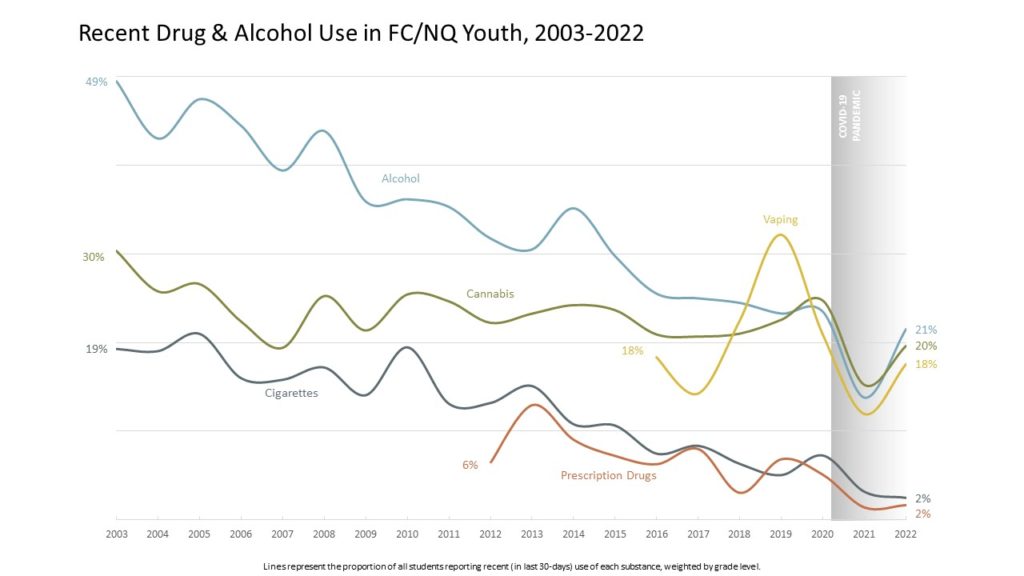
Encouragingly, drug and alcohol use among local youth has declined dramatically over the last two decades, falling to all-time lows in the height of COVID-19 pandemic restrictions, and remaining at-or-below pre-pandemic levels as in-person activities have largely resumed. Even vaping – which appeared suddenly in recent years and increased sharply to nearly a third of all students using vape products in 2018 – has since dropped to less than a fifth of students.

Cannabis use, however, has declined less than other substances, coinciding with students’ attitudes about its risks relaxing considerably. With a suite of major state policy changes since 2012 and a multi-billion-dollar commercial industry with highly-visible advertisement in its wake, students are acutely aware of new norms. “We do what adults do and what people who we think are responsible do”, said a local middle school student participating in a recent focus group on substance use. “If we think it’s cool or respectable, we want to replicate that behavior because that might make us cool or respectable.”

This year’s survey included an additional look at over 30 risk and protective factors that increase or decrease the chances of substance use, school dropout, teen pregnancy, violence, and mental health issues. These factors were last included in the survey back in 2018 – before the COVID-19 pandemic isolated youth and made them even more dependent on screens. Perhaps not surprisingly, overall protective factors have declined, a demonstration of just how much the pandemic continues to undermine young people’s systems of support.

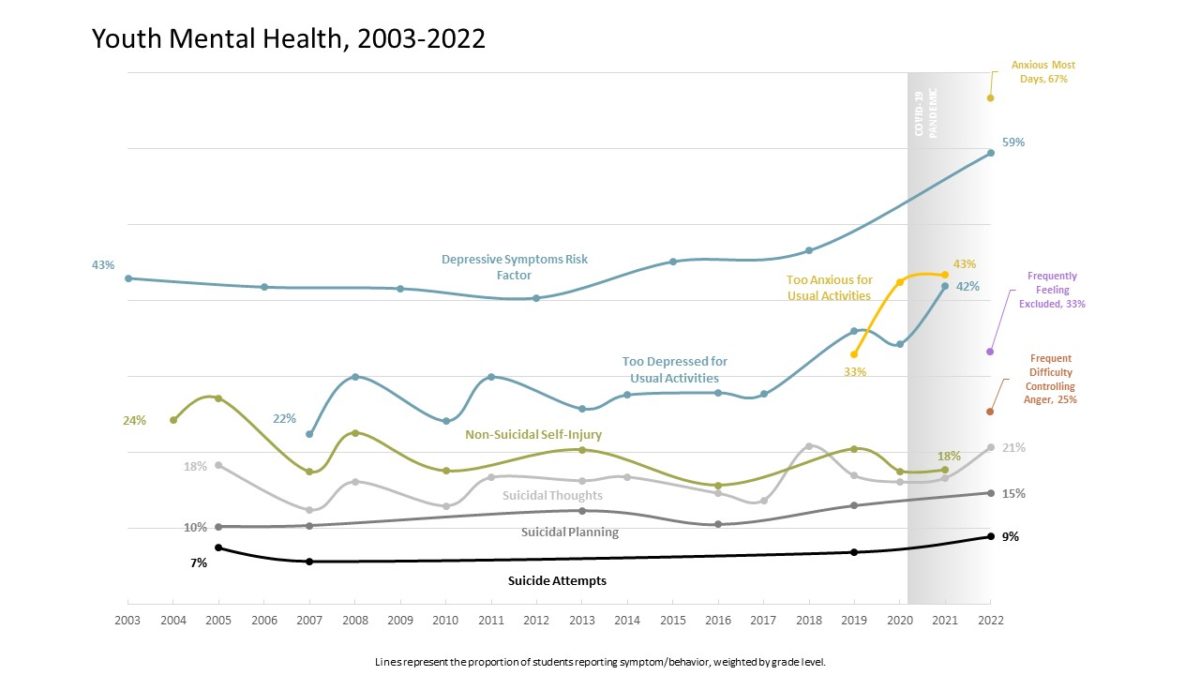
Arguably the most palpable toll reflected in the data is on mental health. Indeed, symptoms of depression and anxiety among students had already been escalating since 2015, but have now skyrocketed to more than half of all students reportedly feeling sad or depressed most days, and two-thirds of students feeling anxious or worried most days. Further, relatively few students are feeling acknowledged for positive social interactions and achievements at home or in the community; and despite ample praise received at schools, students are feeling less committed than ever to their school.

There are many efforts underway in the community to support youth mental health, including expanded access to clinical therapies; LGBTQ+-affirming social groups; evidence-based social and emotional skill-building programs in local schools, arts programs, sports programs, peer-to-peer supports, and more. In the data release, the Coalition also underscored the importance of family attachment – a measure which the Student Health Survey data shows has improved considerably locally over the last 20 years. Contrary to what parents may think at times, the importance of young people feeling connected and supported at home cannot be understated, and is strongly correlated with improved mental health.

A slide show, narrated video presentation, and other materials for the 2022 Student Health Survey can be found at CommunitiesThatCareCoalition.com/Surveys.